Wednesday, 8 June 2011

Rhythm

An entry in the Glossary project

The distribution of a film’s audio-visual properties in time. Nanneman, frustrated by the primitive and unquestioned rhythmic values that narrative filmmakers had always adopted for their works, provided 8 new rhythmic templates according to which his components could be arranged. While the idea was still being developed, Nanneman held an impromptu demonstration evening in the basement of Manchester’s shuttered Central Library, in which he re-cut several well-known local films to approximate the effects of his new rhythms. The occasion was not well attended, but at least two fist-fights broke out and the event marked a turning point in Nanneman’s attitude towards developing his ideas in an open forum.

Here are Nanneman’s rhythmic templates explained:

1. Rhythm of dialogue. Composed of sixty-four sub-grids in which the dialogue - with the other film elements anchored to it - could be arranged. These were mainly based on familiar Mancunian cadences but also included settings inspired by the wider world of rhythm, such as ‘tango’ and ‘bossa nova’.
2. Rhythm of feeling. Responding to the emotional pulses.
3. Rhythm of moral. Early on in the development of the Catalogue, Nanneman posited the existence of ‘moral rhythms’: complex editing patterns which, when repeated over the duration of a movie, would induce in the minds of the audience the correct moral perspective on the content therein. Nicknaming such rhythms "breathing patterns for the eyes," Nanneman hit the lab with the intention of identifying and replicating sixteen distinct moral beats, soon downscaled his efforts to the pursuit of four such patterns, and eventually finished work on just one moral (the obvious one).
4. Rhythm of light. Responding to the movement of light around the 2-dimensional screen space.
5. Rhythm of luminance. A simple algorithm which calculates the total lumen value of each frame and adjusts the duration of that frame accordingly, with brighter images passing more quickly and longer looking times for darkness.
6. Rhythm of character. Inspired by the temporal expressionists. Applying the level-settings of a chosen character’s traits to the respective time value of every other element of the film to create a complex and disorienting dance of plot, props, gesture etc. Thus the character’s relationship to each element of his screen world is illustrated through duration and repetition rather than figural proximity across the 2-dimensional space.
7. Rhythm of audience. Farming the audience’s own rhythms and processing them in real time to create a dynamically responsive structure for the pre-selected content of a film. Unsure whether this method would provide the ultimate synergetic cinema experience, or create unwatchably puerile bilge, or possibly just result in unmanageable levels of feedback, Nanneman deliberately made the instructions ambiguous and there is no recorded example its successful utilisation.
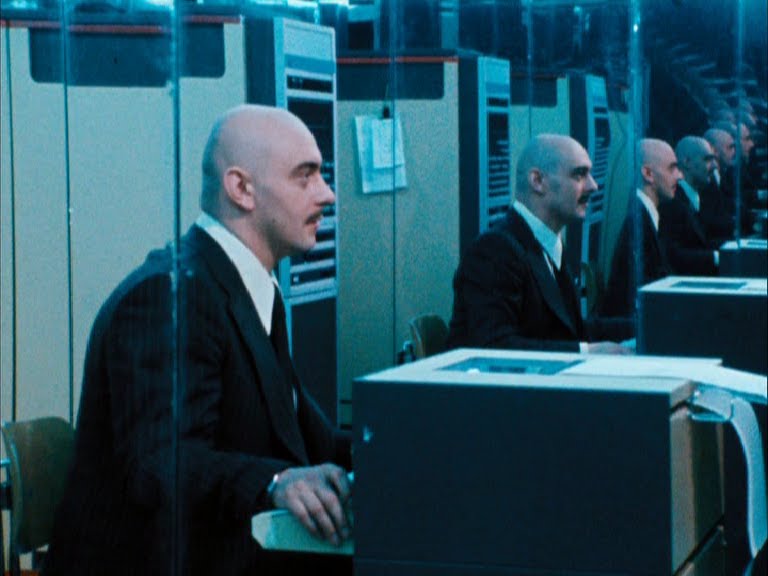
8. Freestyle. The ability to go off-grid.

Previous Entry - Glossary Index - Next Entry

Tuesday, 7 June 2011

Backgrounds

An entry in the Glossary project

As an idealistic young civil servant, years before the inception of the Catalogue project, Nanneman’s efforts to understand the city of Manchester were frequently outrun by his desire to influence and improve it. Nanneman’s idea for an upturned and sunken city, a metropolis in which the windows of the buildings would lay on the earth’s surface and simultaneously reflect and take energy from the sun, and into the 'back' of which - towards the earth’s core - we would hurry in our harnessed boots in times of climatic or environmental distress, and the right-angled window-roofs of which would form, as we lay upright to sleep, a nocturnal study area for hairdressers and statisticians, may well have been inspired by the bizarre perspectives he experienced during al fresco trapeze sessions. Critics have scoffed that Nanneman would have considered himself, in such a world, a kind of perpendicular god. But such a poke at Nanneman’s architectural earnestness overlooks the importance of his early cityscape sketches to our understanding of Nanneman the man, and to his later work on the Catalogue. Working along the corridor from Manchester’s cliquish city planning department, Nanneman must have known even as he drew that his basement city would never be built: that it would exist only, but not merely, as an imaginary city, perhaps to be wandered by those trapped meanwhile in the penthouses of his own memory and who were deprived, like the sideways city, of physical manifestation. However, the city’s flatness, its submersion, the topsy-turvy topography itself drawn from the dizzying isolation of thousands of hours of trapeze work, would later be transformed into the flat worlds of his redestructivish cinema vision - in the demotion of the third dimension, in the essential separateness of parallel planes, in the partial re-angling of obsolete artefacts to serve new purposes, and in the overwhelming redestructivish tendency to turn in on itself: Nanneman’s city was, at heart, an impulse to release a fleet of steel- and glass-churning ploughs across the cityscapes that he’d always found emotionally inhospitable, and neaten up whatever remained.

It was perhaps in deference to his early urbanist ambitions that Nanneman did not later transform this - his most ambitious - cityscape blueprint into a useable redestructivish Background, instead appending digital fascias to Hanni’s comprehensive videography of Manchester’s outer surfaces, the nature of which can only now be appreciated through the surviving labels - City With Swellings, Tropical Metropolis, Anonymous City, Wooden Town, and so on. Or perhaps the superficiality of these urban visions, in contrast to the complex, warped optimism of his early sketches, reflected Nanneman’s realisation that it would take a force greater than the will of a provincial civil servant to realign the character of a city whose flesh, no matter how smartly swathed in the attire of a communication age it played no small part in creating, remained stubbornly ingrained with the soot of industrial-economic subservience.
Previous Entry - Glossary Index - Next Entry

Monday, 21 March 2011

It's Nick's Birthday in Aubagne

Feet bleeding, the dancing celluloid heroes of our Super-8 musical It's Nick's Birthday limp on to another festival screening this week, at Aubagne near Marseille:

It's Nick's Birthday @ 11th International Film Festival of Aubagne

WHERE: Theatre Comedia, 7 Bd Jean Jaurès, 13400

WHEN: Thursday 24th March, 2011, 19.45

COST: enquire at venue


Thursday, 10 March 2011

Do you have any idea how this might have happened? and 47 other questions, with no answers, in alphabetical order

It is something of a cliché, or better said “truism”, to state that a film or a piece of art that one has created does not attempt to provide any answers (“I wouldn’t be so bold”) but only to ask questions.

As a filmmaker and pre-maker, it’s an excuse that I unashamedly subscribe to. I’m dim but curious, so I think I’ve got things the right way around.


In the name of transparency, and of self-justification, I thought it might be time to share a few of the key questions that emerge in the work produced here at the Institute
, plainly and unobfuscated by the convolutes of aesthetics or narrative.

Here, in strict semi-alphabetical order, are 48 of the most pressing questions that our work raises
:

Am I in your way?

Are you some sort of idiot?
Couldn’t we just try?
Does this bother you?
Do I have to get up?
Do you expect me to touch that?
Do you have any idea how this might have happened?
Do you think I’m some sort of idiot?
How do you work this thing?
How far will you go to stop me?
How much is too much?
How the hell am I going to get out of this?
How the hell did I wind up in this?
Is doing that going to hurt more or less than not doing that?
Is that supposed to be funny?
Is this ever going to end?
Is this your dog?
Shouldn’t we give the whole thing up?
Shouldn’t we stick together?
What are the chances of getting out of this alive?
What are the chances of retaining my dignity?
What are you doing with that thing?
What are you trying to say?
What do you think that behaviour’s going to achieve?
What’s it worth to me?
What’s on your mind?
What’s that look for?
What’s the big idea?
What’s the worst that could happen?
What the hell were you thinking?
What time’s the last train?
Where am I?
Where did you go?
Where is it?
Who am I?
Who are you?
Who do you think you’re talking to?
Who’s going to clear this up?
Who’s that man?
Why are you hitting me?
Why did you hide it?
Why is he crying?
Why is she screaming?
Why me?
Why oh why oh why?
Won’t you leave me alone?
Would you like to dance?
Would you recommend [subject matter of film] to your friends?

Please feel free to add questions via the comments box if you believe there are any major themes I’ve overlooked. Once we’ve got all the key questions here in one place we can stop making art and hand it all over to the scientists to deal with.


Friday, 31 December 2010

Let's just try and take 2011 one stupid day at a time

This time last year, I predicted that this time this year (i.e. now) everyone would be compiling predictions as to what will happen next year (2011) - and I was right.

Building on the success of last year's prediction, I have compiled a list of top tips for the filmmaking trends and tropes of '11. Here they are in no particular order, except for alphabetical:

Butter

Nobody knows what the real fall-out is going to be from the demise of the Film Council. Filmmakers are facing unsure times now that it's unclear who we should butter up to and why we wasted so much time buttering up to the previous administration. The industry therefore has a surplus of emotional 'butter' which will surely be spread over the subject matter of its output, although it’s too soon to say whether this will manifest itself metaphorically or otherwise.

Furthermore, there will be a portion of butter (metaphorical) for each and every one of our darling online supporters as we try to milk them, piecemeal, for the budget of our next picture. This is called crowd-funding and, considering the feeding of cow offal to cows resulted in BSE, the Institute advises against it in its purest form. Instead, try the alphabetically convenient:

Crowd-producing

Similar to crowd-funding, but more hands on, 'crowd-producing' involves directly engaging an online fanbase with the ongoing production process. A list of tasks (chiefly: sums, phone calls and ego-management) considered too mundane for the director but too important for the crew will be made available online, with fans encouraged to pick a 'chore' and deal with it efficiently parallel to sorting out their own complex problems (messy divorce, looming audit into dodgy former business). Like crowd-funding, crowd-producers will be expected to stump up cash for their slice of the glory, but in this case it does not have to be their own.

The Institute is also looking into ways of making 'crowd-mothering' - a network of reassurance and (where feasible) hugs for insecure filmmakers - into a workable initiative.

Increased importance of L'Institute Zoom on global film scene

Here's Armend, the Institute's marketing man: "We do a variety of fine work here at the Institute, and we also make films. By ceaselessly going on about what we're doing and thinking about doing, and bandying our name around in connection with upcoming awards until it's a virtual inevitability that we'll win them, our marketing strategy is intended to catapult us right past 'annoying' and into the lucrative realm of 'familiar background noise'."

Words are cheap in the internet age - there are over 1,000 of them in this important and prophetic article alone!

Notworking

What is your USP? Last time I went to a networking event I left after thirty minutes and threw up next door, then came back and told everyone I met that I'd just sicked and that I was developing a web series about electronic brain augmentation. People were genuinely interested in the sick.

Already a prevalent trend, Notworking is to Networking what Cloud Gazing is to Cloud Computing. The idea is that while you sit down by yourself and have a cup of tea, the ether/the others can sort themselves out and inspire/inform/employ you at their will. Notworking is at its best unpredictable, and at its worst pleasantly predictable. The important thing is to allocate a precise time when you are Notworking, otherwise you are just not working, which can be guilt-intensive.

Nuisance Campaigns

Combining the sophisticated punch-in-the-face tactics of internet rollover ads with the time-proven effectiveness of the nagging child, Nuisance marketing will be the phenomenon you can't escape in 2011. GPS and online social networking will enable pushy campaign teams to track the movement and desires of the potential audiences. When the marketing team becomes aware of a congregation of the appropriate demographic (in pubs, shopping centres, at funerals), they will spring into 'life' to create thematically linked 'situations', which the target audience must negotiate in order to 'survive' or 'escape', depending on the theme of the film. (This idea was originally conceived by Guy Debord, but he didn't word it very well and nobody thought they could make any money out of it). Cloned SIM cards and hoax profile pages will be used to stir up and externalise the tension hinted at in the semi-public relationships of online social network users, creating a genuinely malevolent 'nuisance'. The Nuisance campaign will continue until each would-be audience member gives in and commits to seeing the film.

In the case of smaller arthouse films, a one-to-one stalking-type approach will be utilised. The underpaid but otherwise jobless quirky-faced star of the movie will travel from city to city with the director and his girlfriend, and spend a week at a time personally harassing (in character) the handful of local pseuds whose purposely obscure online Likes suggest they might actually 'get' the film and forgive its dismal production values. When the locals have created a vehement enough online campaign to justify a screening, the director will arrange for the film to be shown on the city's Big Screen, or just underneath it on his MacBook.

3D-Nausea

I think I mentioned this on Twitter once but I haven't worked out all the technicalities yet and just want to reassert it was my idea before someone steals it. Basically, "3D-N" is metaphysical 3D for existential arthouse-type films. The characters and locations appear all around you in suffocating detail, but it feels like something's missing.

Hats

This year we'll be seeing a lot of movie villains in hats.

Thursday, 9 December 2010

Aidan Smith awarded "Best Music" for It's Nick's Birthday score

We are most proud to announce that the Institute's staff composer Aidan Smith has been awarded "Best Music" for his It's Nick's Birthday score at La Cabina Medium-Length Film Festival, Valencia.

Whilst the Institute's staff were too thinly spread over other award ceremonies, diplomatic functions etc., to attend the prize-giving in Valencia, it has been reported that on being told the news privately Mr Smith responded with modesty, gratitude, and bouts of nervous mock-boasting followed by fierce self-degradation and an unsureness about where to look.

Mr Smith's solo work can be appreciated here, with his nightwear/pop outfit Pyjama Party represented here.

(Here follows a music video the Institute made with Mr Smith some years back).