Showing posts with label character. Show all posts

Monday, 9 January 2012

Undepth In Real People And Those Who Believe They’re Real

An entry in the Glossary project

Francis Dove’s notorious 60,000 word tutorial on character development in film and television productions was serialised over eight issues of the screen industry journal SquareEyes against the will of its then editor, who handed in his resignation when the legal department insisted that a hidden clause in Dove’s contract compelled them to publish anything Dove submitted for print. With no-one else willing to take on the editorship under such conditions, the journal fell under the unofficial control of Dove himself, becoming a textual ghetto for his increasingly unpalatable ideas on film, life and the hybridization of the two.

Only the abstract survives:
Everybody knows that in fiction, if you want to create a deep character all you have to do is create a very consistent character who does something surprising at the end of the second act. In life, of course, we know that when someone does something unpredictable it us usually due to a partly formed or poorly defined personality, or that they are always doing unpredictable things to try and hide a self-perceived shallowness. To really say that someone is more or less deep is an over-neat metaphor for the human condition: we are, more accurately, all equally shallow (though some taller than others), but with different (and fluctuating) levels of turbulence, pressure and indigenous life. However, these are not our concerns here: if you want to create a deep character all you have to do is create a very consistent character who does something surprising at the end of the second act. How have the artisans of film and television worked, and may they continue to rework, this formula again and again and again to give the illusion of real actual inner life?
Somebody, at least, was reading: Volodymyr Nanneman made substantial changes to the character-generating function of his electronic filmmaking kit, apparently alarmed by the misanthropy he saw in Undepth In Real People And Those Who Believe They’re Real. Dove, however, insisted his paper was a gesture of deep affection towards his colleagues, rivals and humankind in general.

Monday, 5 September 2011

Character Type

An entry in the Glossary project

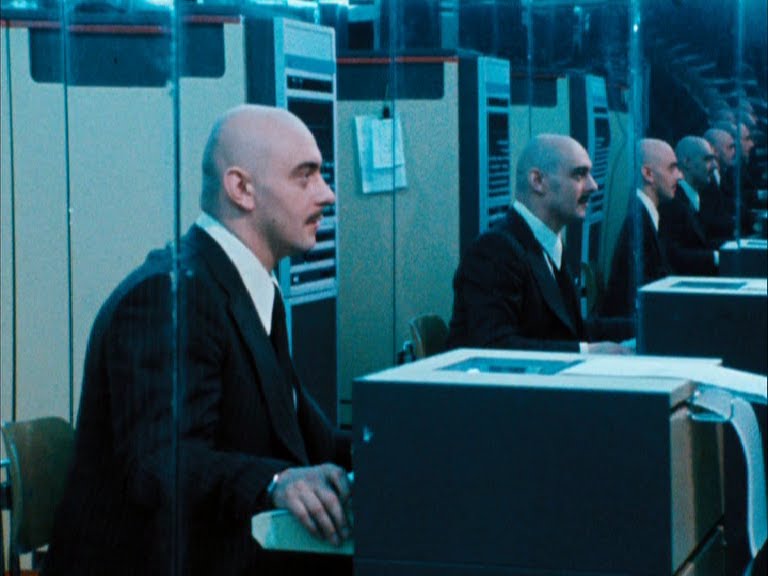
Nanneman was pressured, during a washroom encounter with his line manager, to keep to the latter's list of "16 character types (17 for an art-house film)" when designing the character-generating feature of his filmmaking kit. So as not to jeopardise the continued asssembly of the Catalogue - which had already been vetoed from above and which his line manager, having stumbled upon Nanneman's misuse of city council lab space by mistake, was by turns tolerating and interfering with - Nanneman ostensibly integrated his superior's list, but reduced each of the 16 broad 'types' to its key trait and generated 65,536 new character types by exploiting every possible combination of those qualities. (He excluded the arty 17th type for obvious reasons). The psychological complexity of these new redestructivish archetypes meant that Nanneman was able to create distinct imprints of every one of them using just two actors: himself and his second wife*. Every time one of these intricately designed algorithms was given a new name, wardrobe, haircut and surroundings he or she became a unique character (excepting the improbable eventuality of another filmmaker happening to choose the same type, name and look and putting this ‘new’ character into the same situation).

It is not known which 16 traits Nanneman divined from his line manager's original types, but we do know that he excluded any 'opposites' which might have cancelled each other out. Instead, Nanneman assumed that certain traits - e.g. faith - are an a priori human characteristic so included only their opposite - e.g. incredulity - amongst the 16 potential attributes: if a character lacked any one of the 16 'nurtured' traits he was assumed to have its opposite through nature. Whilst Nanneman acknowledged that such opposites don't always exist in pure dichotomy but on a sliding scale, he considered such nuances to be uncommon and irrelevant to the cinematic representation of human nature, certainly in a time when audiences needed reassurance, not speculation. In the circus and in the civil service, it had tended to be Nanneman's experience that people were one thing or another, and any apparent gradation in between usually boiled down to a case of deception or illness. Hanni, charged with finding "8 good rules" with which to shape the Nannemans' performanced blueprints of the thousands of archetypes Volodymyr had created, briefly looked into the old social networking websites, and discovered that everything Nanneman had suggested about human nature was more or less true. However, in response to the publication of Francis Dove's misanthropic Undepth In Real People And Those Who Believe They’re Real, Nanneman relented, creating a set of digital faders for the adjustment of the archetypes' character trait level-settings, allowing access to the middle ground between opposing traits. The knobs on the interface were all the same deliberately designed "stubborn" to discourage their use.

On discovering the zealous manner in which his underling had misinterpreted his original instructions, Nanneman’s line manager is said to have remarked that, the Nannemans having between them taken the time to create 65,536 characters, perhaps the unremittingly earnest Volodymyr should, from then on, himself be referred to as "Character Zero".

*(we know from his tattoos that she was called Hanni)

Wednesday, 8 June 2011

Rhythm

An entry in the Glossary project

The distribution of a film’s audio-visual properties in time. Nanneman, frustrated by the primitive and unquestioned rhythmic values that narrative filmmakers had always adopted for their works, provided 8 new rhythmic templates according to which his components could be arranged. While the idea was still being developed, Nanneman held an impromptu demonstration evening in the basement of Manchester’s shuttered Central Library, in which he re-cut several well-known local films to approximate the effects of his new rhythms. The occasion was not well attended, but at least two fist-fights broke out and the event marked a turning point in Nanneman’s attitude towards developing his ideas in an open forum.

Here are Nanneman’s rhythmic templates explained:

1. Rhythm of dialogue. Composed of sixty-four sub-grids in which the dialogue - with the other film elements anchored to it - could be arranged. These were mainly based on familiar Mancunian cadences but also included settings inspired by the wider world of rhythm, such as ‘tango’ and ‘bossa nova’.
2. Rhythm of feeling. Responding to the emotional pulses.
3. Rhythm of moral. Early on in the development of the Catalogue, Nanneman posited the existence of ‘moral rhythms’: complex editing patterns which, when repeated over the duration of a movie, would induce in the minds of the audience the correct moral perspective on the content therein. Nicknaming such rhythms "breathing patterns for the eyes," Nanneman hit the lab with the intention of identifying and replicating sixteen distinct moral beats, soon downscaled his efforts to the pursuit of four such patterns, and eventually finished work on just one moral (the obvious one).
4. Rhythm of light. Responding to the movement of light around the 2-dimensional screen space.
5. Rhythm of luminance. A simple algorithm which calculates the total lumen value of each frame and adjusts the duration of that frame accordingly, with brighter images passing more quickly and longer looking times for darkness.
6. Rhythm of character. Inspired by the temporal expressionists. Applying the level-settings of a chosen character’s traits to the respective time value of every other element of the film to create a complex and disorienting dance of plot, props, gesture etc. Thus the character’s relationship to each element of his screen world is illustrated through duration and repetition rather than figural proximity across the 2-dimensional space.
7. Rhythm of audience. Farming the audience’s own rhythms and processing them in real time to create a dynamically responsive structure for the pre-selected content of a film. Unsure whether this method would provide the ultimate synergetic cinema experience, or create unwatchably puerile bilge, or possibly just result in unmanageable levels of feedback, Nanneman deliberately made the instructions ambiguous and there is no recorded example its successful utilisation.
8. Freestyle. The ability to go off-grid.

Previous Entry - Glossary Index - Next Entry