Monday, 13 June 2011

Establishing shot

An entry in the Glossary project

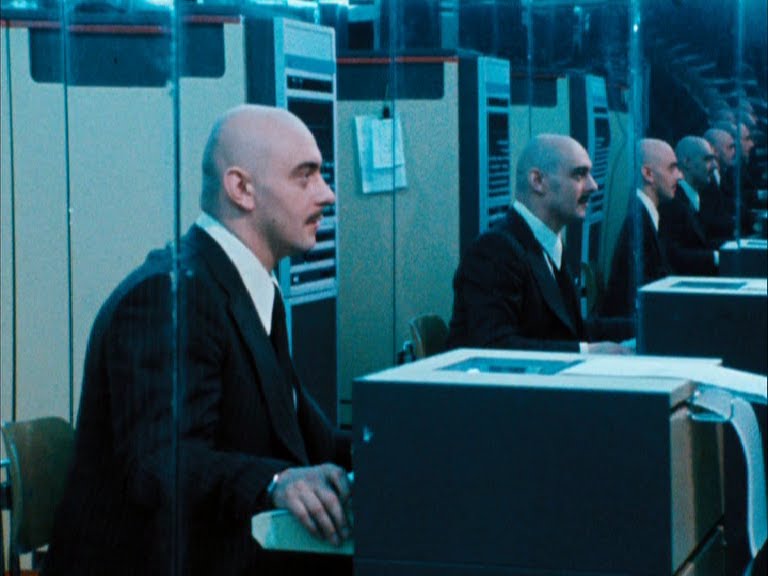
Not to be confused with their more integrative Backgrounds, the Nannemans’ establishing shots comprised a portfolio of static, un-modifiable exterior shots designed to be slotted into an edit in order to broadcast the fact of the subsequent scene’s location to the audience.


Whilst creating a test film from an early version of the Catalogue, Hanni apparently became confused over the concept of the establishing shot and ended up using the same one for every location. She was, some have speculated, so used to seeing the raw materials of the interior scenes laying around her husband’s lab in the Town Hall that, when it came to signposting the site of each interior with an exterior shot, she was unable to imagine any more suitable frontage than that of the city council headquarters itself – whether the interior that followed was that of a house or school or sports arena. More generous commentators have claimed that Hanni was in fact trying to make a profound phenomenological point: we never stray from the base of our own perception so place is just a state of mind.


The test film was unpopular among Nanneman’s colleagues, although whether this was an academic response to Hanni’s misuse of form or a visceral reaction to the unsettling viewing experience is unclear. Such was the provocative nature of Hanni’s film that several unnamed civil servants banded together one evening after drinks to create a sarcastic reply-film on a finance undersecretary’s mobile phone. Hanni’s contentious method was inverted so that, in the reply-film, a different establishing shot was videoed for each of several consecutive scenes manifestly set in the same interior location as each other. Thus a recurring argument in a fictitious if rather familiar office setting was variously introduced by images of a burger bar, a toll booth, a dog kennel, a hunting cabin, a river bed, a mountain range, deep space etc. The move backfired as the finished video, in its inadvertently emotive juxtaposition of the absurdity of modern man’s Sisyphean struggle and the diverse enormity of a universe in which we may be considered little more than mites with carpentry skills, may have genuinely countered Hanni’s solipsistic statement (if that’s what it was) but offered no less depressing an alternative. Whether Hanni ever saw this video riposte is not known, as the undersecretary subsequently took a six month sabbatical and, upon his return, was seen to have replaced his mobile phone.
Thursday, 9 June 2011

Subject D

An entry in the Glossary project

At the age of eleven, Nanneman spent one lunatic summer creating looped studies of himself engaged in mundane human behaviours (brushing his teeth, feeding the elephants), using an SVHS camera he had found apparently abandoned near a campsite outside Widnes. Each study was 24 minutes long but designed to loop indefinitely. The videos could play faster or slower so that, for example, a video of him brushing his teeth for 24 minutes real time could be slowed down for detailed observation, or sped up to correctly represent the average duration of the unvideoed process as timed twice daily over a period of 28 days: it could not, however, be trimmed or electronically spliced due to a lack of cables. His contemporaries (he later recalled) described Nanneman’s studies as "fascinating" and "very good", although it should be noted that they did not have regular access to other screen media, and that viewing the videos through the eyepiece of the camera must have accentuated an already vivid and exciting sense of illicitness.

The demands of such a pursuit were clearly in conflict with those of Nanneman’s rigorous training regime and, what with the project’s effect on the discipline of the circus’s younger members, it was only a matter of time before the camera was confiscated by the company’s deputy ringmaster. Nanneman promptly stole it back and continued his studies within the secure confines of a locked bathroom trailer until the camera suffered irreparable water damage, becoming useful thereafter only as an un-working anatomical model, which Nanneman speculatively reconfigured into a series of new recording devices which were, of course, equally un-working. Nanneman would later refer to his childhood studies regularly, particularly a sub-category of the work which involved extensive documentation of the behaviour and response patterns of a dog, by way of contextualising the results of his laboratory work at the city council. The identity of the dog remains unknown, Nanneman having only ever referred to him as ‘Subject D’.

Wednesday, 8 June 2011

Rhythm

An entry in the Glossary project

The distribution of a film’s audio-visual properties in time. Nanneman, frustrated by the primitive and unquestioned rhythmic values that narrative filmmakers had always adopted for their works, provided 8 new rhythmic templates according to which his components could be arranged. While the idea was still being developed, Nanneman held an impromptu demonstration evening in the basement of Manchester’s shuttered Central Library, in which he re-cut several well-known local films to approximate the effects of his new rhythms. The occasion was not well attended, but at least two fist-fights broke out and the event marked a turning point in Nanneman’s attitude towards developing his ideas in an open forum.

Here are Nanneman’s rhythmic templates explained:

1. Rhythm of dialogue. Composed of sixty-four sub-grids in which the dialogue - with the other film elements anchored to it - could be arranged. These were mainly based on familiar Mancunian cadences but also included settings inspired by the wider world of rhythm, such as ‘tango’ and ‘bossa nova’.
2. Rhythm of feeling. Responding to the emotional pulses.
3. Rhythm of moral. Early on in the development of the Catalogue, Nanneman posited the existence of ‘moral rhythms’: complex editing patterns which, when repeated over the duration of a movie, would induce in the minds of the audience the correct moral perspective on the content therein. Nicknaming such rhythms "breathing patterns for the eyes," Nanneman hit the lab with the intention of identifying and replicating sixteen distinct moral beats, soon downscaled his efforts to the pursuit of four such patterns, and eventually finished work on just one moral (the obvious one).
4. Rhythm of light. Responding to the movement of light around the 2-dimensional screen space.
5. Rhythm of luminance. A simple algorithm which calculates the total lumen value of each frame and adjusts the duration of that frame accordingly, with brighter images passing more quickly and longer looking times for darkness.
6. Rhythm of character. Inspired by the temporal expressionists. Applying the level-settings of a chosen character’s traits to the respective time value of every other element of the film to create a complex and disorienting dance of plot, props, gesture etc. Thus the character’s relationship to each element of his screen world is illustrated through duration and repetition rather than figural proximity across the 2-dimensional space.
7. Rhythm of audience. Farming the audience’s own rhythms and processing them in real time to create a dynamically responsive structure for the pre-selected content of a film. Unsure whether this method would provide the ultimate synergetic cinema experience, or create unwatchably puerile bilge, or possibly just result in unmanageable levels of feedback, Nanneman deliberately made the instructions ambiguous and there is no recorded example its successful utilisation.
8. Freestyle. The ability to go off-grid.

Previous Entry - Glossary Index - Next Entry

Tuesday, 7 June 2011

Backgrounds

An entry in the Glossary project

As an idealistic young civil servant, years before the inception of the Catalogue project, Nanneman’s efforts to understand the city of Manchester were frequently outrun by his desire to influence and improve it. Nanneman’s idea for an upturned and sunken city, a metropolis in which the windows of the buildings would lay on the earth’s surface and simultaneously reflect and take energy from the sun, and into the 'back' of which - towards the earth’s core - we would hurry in our harnessed boots in times of climatic or environmental distress, and the right-angled window-roofs of which would form, as we lay upright to sleep, a nocturnal study area for hairdressers and statisticians, may well have been inspired by the bizarre perspectives he experienced during al fresco trapeze sessions. Critics have scoffed that Nanneman would have considered himself, in such a world, a kind of perpendicular god. But such a poke at Nanneman’s architectural earnestness overlooks the importance of his early cityscape sketches to our understanding of Nanneman the man, and to his later work on the Catalogue. Working along the corridor from Manchester’s cliquish city planning department, Nanneman must have known even as he drew that his basement city would never be built: that it would exist only, but not merely, as an imaginary city, perhaps to be wandered by those trapped meanwhile in the penthouses of his own memory and who were deprived, like the sideways city, of physical manifestation. However, the city’s flatness, its submersion, the topsy-turvy topography itself drawn from the dizzying isolation of thousands of hours of trapeze work, would later be transformed into the flat worlds of his redestructivish cinema vision - in the demotion of the third dimension, in the essential separateness of parallel planes, in the partial re-angling of obsolete artefacts to serve new purposes, and in the overwhelming redestructivish tendency to turn in on itself: Nanneman’s city was, at heart, an impulse to release a fleet of steel- and glass-churning ploughs across the cityscapes that he’d always found emotionally inhospitable, and neaten up whatever remained.

It was perhaps in deference to his early urbanist ambitions that Nanneman did not later transform this - his most ambitious - cityscape blueprint into a useable redestructivish Background, instead appending digital fascias to Hanni’s comprehensive videography of Manchester’s outer surfaces, the nature of which can only now be appreciated through the surviving labels - City With Swellings, Tropical Metropolis, Anonymous City, Wooden Town, and so on. Or perhaps the superficiality of these urban visions, in contrast to the complex, warped optimism of his early sketches, reflected Nanneman’s realisation that it would take a force greater than the will of a provincial civil servant to realign the character of a city whose flesh, no matter how smartly swathed in the attire of a communication age it played no small part in creating, remained stubbornly ingrained with the soot of industrial-economic subservience.
Previous Entry - Glossary Index - Next Entry

Monday, 21 March 2011

It's Nick's Birthday in Aubagne

Feet bleeding, the dancing celluloid heroes of our Super-8 musical It's Nick's Birthday limp on to another festival screening this week, at Aubagne near Marseille:

It's Nick's Birthday @ 11th International Film Festival of Aubagne

WHERE: Theatre Comedia, 7 Bd Jean Jaurès, 13400

WHEN: Thursday 24th March, 2011, 19.45

COST: enquire at venue


Thursday, 10 March 2011

Do you have any idea how this might have happened? and 47 other questions, with no answers, in alphabetical order

It is something of a cliché, or better said “truism”, to state that a film or a piece of art that one has created does not attempt to provide any answers (“I wouldn’t be so bold”) but only to ask questions.

As a filmmaker and pre-maker, it’s an excuse that I unashamedly subscribe to. I’m dim but curious, so I think I’ve got things the right way around.


In the name of transparency, and of self-justification, I thought it might be time to share a few of the key questions that emerge in the work produced here at the Institute
, plainly and unobfuscated by the convolutes of aesthetics or narrative.

Here, in strict semi-alphabetical order, are 48 of the most pressing questions that our work raises
:

Am I in your way?

Are you some sort of idiot?
Couldn’t we just try?
Does this bother you?
Do I have to get up?
Do you expect me to touch that?
Do you have any idea how this might have happened?
Do you think I’m some sort of idiot?
How do you work this thing?
How far will you go to stop me?
How much is too much?
How the hell am I going to get out of this?
How the hell did I wind up in this?
Is doing that going to hurt more or less than not doing that?
Is that supposed to be funny?
Is this ever going to end?
Is this your dog?
Shouldn’t we give the whole thing up?
Shouldn’t we stick together?
What are the chances of getting out of this alive?
What are the chances of retaining my dignity?
What are you doing with that thing?
What are you trying to say?
What do you think that behaviour’s going to achieve?
What’s it worth to me?
What’s on your mind?
What’s that look for?
What’s the big idea?
What’s the worst that could happen?
What the hell were you thinking?
What time’s the last train?
Where am I?
Where did you go?
Where is it?
Who am I?
Who are you?
Who do you think you’re talking to?
Who’s going to clear this up?
Who’s that man?
Why are you hitting me?
Why did you hide it?
Why is he crying?
Why is she screaming?
Why me?
Why oh why oh why?
Won’t you leave me alone?
Would you like to dance?
Would you recommend [subject matter of film] to your friends?

Please feel free to add questions via the comments box if you believe there are any major themes I’ve overlooked. Once we’ve got all the key questions here in one place we can stop making art and hand it all over to the scientists to deal with.