Showing posts with label 'I'. Show all posts

Monday, 10 October 2011

Indirection

An entry in the Glossary project

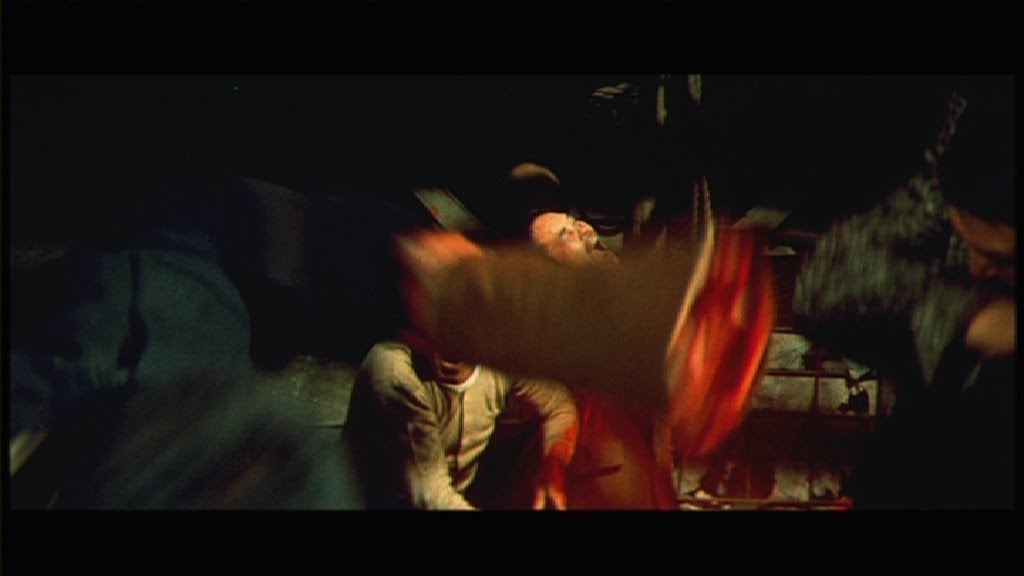
The deliberate withholding of audio or visual information, usually by obscuring it with other matter (sound, set) or out of frame or hearing range, but with its properties hinted at by that information which remains. For example, the physical goings-on in a foggy sauna may only be suggested by the screams of unseen participants, the facial expressions of a foregrounded attendant or the peculiar movement of the steam.

Nanneman’s guide to the appropriate use of indirection is here paraphrased in lieu of his original text:
What you know that you can’t see makes what you can see hilarious; what you don’t know that you can’t see doesn’t bother you. What you suspect is being hidden from you makes you resentful towards a movie, while the showing of that which needn’t have been shown provokes disdain. The revelation of that which was previously hidden brings catharsis, the hiding of that which was previously visible brings disorientation. Summed up: while its excessive or insensitive use may compromise the intended effect on a movie’s audience, indirection can be a great boon to the filmmaker on a budget.
See also: Implicit, the

Monday, 12 September 2011

Intern's Palette, The

An entry in the Glossary project

Having hunted, indexed and categorized his (revised) target of 16, 384 colours, Nanneman set the work experience boy the task of creating full back-stories for each hue. Given the vigour with which the unnamed teen took to his work, he must either have believed Nanneman’s lie-by-omission that the project was a genuine City Council task passed on by colleagues tired just by the scale of the project, or been enthusiastic and quite stupid as many of the happier of people are, or, as is most likely, some of Nanneman’s quixotic fervour rubbed off on him. Whatever way around, it was some feat for him to complete, as he did, biographies several pages long for each of precisely 256 colours in the two weeks before he was obliged to return to school. There are indications that Nanneman was all the same disappointed at the tiny dent made in the full spectrum of redestructivish colours and, given that his superiors refused him custody of any further work experience students, progress on further colour back-stories was sporadic. The work experience boy’s accomplishment stands therefore as the largest fully-documented colour range in the Catalogue, and it is from the informal name that this collection became known by that the phrase "the intern’s palette" passed into popular use to indicate a naïve and incomplete glimpse of a utopian new system within the breakaway department of an immoveable institution.

Monday, 27 June 2011

Implicit, The

An entry in the Glossary project

In its redestructivish sense, the Implicit is the inverse of Visual Matter or, to put it another way, the essence that fills the holes in the mise-en-scene.

Nanneman stated that although the Implicit was intangible and existed only as an unambiguous natural force that would come into being between any two or more of his components once activated, there would still be a small fee applicable for its use. Hanni took to referring to this fee as a "subtext tax", although Nanneman discouraged her use of this term as it just confused things. The Implicit was an aesthetic side-effect which, whilst unavoidable, could hardly be considered vital to any movie, while the subtext was an essential structural tool which Nanneman suggested had been, since the birth of cinema, "screenwriting’s dark little secret".

For Francis Dove, Nanneman's idea of the Implicit was too weighted and specific. The gaps between screen presences were "less, even, than essence". While visual matter could be used to contextualise (not define) the nothingness that it framed, that was not the same as making this nothingness something itself. From this perspective, Dove's use of ostentatiously artificial sets, props and performances as a moving architecture of absence can be considered an acknowledgement of the futility of artistic pursuit against the dumb mystery of the universe. His contemporaries alternately labelled Dove’s work as "clunkyist" or "nothingist" depending on the part of the screen to which they were referring: he might more accurately have been described as a nothingist wrapped up in a clunkyist (as a filmmaker) or vice versa (in his day-to-day life).

Dove’s creative partner Harley Byrne, who had enormous respect for Nanneman as a thinker (but not as a man), countered that "just because the unknowable isn’t defined, doesn’t mean we’re unsure what it is," though it is possible that Dove wasn’t listening.