Here follows a quasi-academic essay I wrote in 2015. I hope that somewhere within the bap of my ignorance, amongst the void where the burger of knowledge and understanding should be found, readers might at least stumble upon a gherkin of curiosity. It's a bit over 3,000 words, or a 12 minute read.


Two films either side of May ’68, two visions of an alienated post-war Paris détourned, deconstructed and destroyed by its inhabitants.
Playtime (Jacques Tati, 1967) is an ironic modernist utopia, the city as a machine for living in, unwittingly exploited by Jacques Tati's Monsieur Hulot. His casual clumsiness reshapes Paris as a playground in which human connections can be made in spite of the passive-aggressive urban engineering of his time.
The eponymous anti-hero of Themroc (Claude Faraldo, 1973) lives in a post-’68 Paris where the illusion of a progressive utopia is no longer maintained. As a construction worker in a palpably bricks-and-mortar society, Themroc represents the very fabric of the city – a fabric being pulled to ripping point by inhuman corporate and political forces.
They are fascinating for their contrasting critiques of modernist/post-industrial urbanism, the state of mid-twentieth century western capitalism, and the effect of both on the individual and on groups. Set in Paris at almost the exact same point in history, the city is nevertheless unrecognisable from one movie to the other.
The third key text, from which I will take my cue to interrogate these movies, is Raoul Vaneigem’s The Revolution of Everyday Life – published in the year of Playtime’s release and six years before Themroc. Vaneigem was part of a group known as the situationists (although he notes that “situationism is an ideology that the situationists were unanimous in rejecting. The term “situationist” was ever only a token of identification. Its particularity kept us from being mistaken for the throngs of ideologues.” (Obrist, 2009))
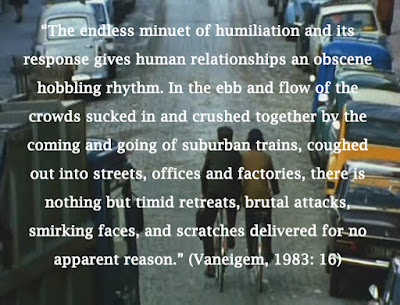
Vaneigem was critical of existing economic powers but specifically their complex entanglement with cultural customs, rituals, and artefacts – ways of life the common individual regards as ‘natural' but which are in fact the building blocks of our oppression, shaped and guided by living history, vested interests and complacency. He notes that dystopian literature such as Huxley's Brave New World and Orwell's 1984 alienate us from meaningful critique because they relocate today's oppression into fears of the future: "Compared with my present imprisonment," he writes, "the future holds no interest for me." (Vaneigem, 1983: 34)
Intriguingly, both Playtime and Themroc operate on the borders of speculative fiction (if not science fiction), although both are set in contemporary Paris. Playtime does it by pushing existing technologies and infrastructures to absurd extremes; Themroc, by positing an alternative dimension in which Parisians speak to each other only in grunts, and physical laws are subtly different to our own. For example, the antihero Themroc gains superhero strength after he revolts and, likewise, the other revolutionaries find themselves immune to tear gas (characterized as ‘HASH PROLETARIEN'). But both movies essentially locate their critiques in an identifiable here-and-now and offer semi-serious strategies for the subversion and overthrow of an everyday life that is easily taken for granted.


The tension of the situationists’ outlook was in the ambivalence of its protagonists’ desires. On the one hand, our way of life is fundamentally flawed, and we would ideally start from scratch. On the other, the bricks of our new society are to be retrieved from the rubble of the existing one. Vaneigem’s text is presented as political philosophy, but it is just as sad as it is angry. The predominant emotion is despair, but its being written was an act of hope.
Look at the names of two situationist exhibitions held in Denmark in the 1960s: ‘Destruktion af RSG-6' and ‘Operation Playtime.' One fantasized about nuclear war; the other hints at situationism’s ludic tendencies (Rasmussen, 2015: 14). Situationism appeals to the guts and to the intellect. Everyday life is not to be considered from a purely political standpoint: it is animal, absurd, physical and ritualistic.
This is what makes cinema, with its multiple forms of sensory communication and invocation, a suitable instrument with which to dissect it. Cinema can look and sound like everyday life, but with unfamiliar perspectives, structured narratives and re-configured physicalities (for example, Hulot's characteristic walking style, which expresses his childlike innocence while inspiring the audience to consider how each of us actually walks around the city. It is a form of Brechtian alienation).
This is what makes cinema, with its multiple forms of sensory communication and invocation, a suitable instrument with which to dissect it. Cinema can look and sound like everyday life, but with unfamiliar perspectives, structured narratives and re-configured physicalities (for example, Hulot's characteristic walking style, which expresses his childlike innocence while inspiring the audience to consider how each of us actually walks around the city. It is a form of Brechtian alienation).
Where Playtime and Themroc excel in this pursuit is their respective use of sound design, framing, and minimal narrative to jerk the viewer from a complacent reading of each movie and reconsider it in the light of their own political circumstances.

The soundscape of Themroc is murky, unpretty – but not imprecise. Playtime – or the first half, before the extended restaurant sequence, at least – is composed of isolated, laboratory-fresh foley objects.
Both films begin with journeys: Themroc rises, gets ready for work and takes the commute; the figure of Hulot, on his way to and from an important meeting, is juxtaposed with a gaggle of tourists on their way from the airport to their hotel.
The key sonic motifs of each of these sequences are opposite in approach but equally dehumanizing. Workers leave Themroc’s apartment block whistling indecipherable tunes, mount their squeaking bicycles and lean on each other for support, already becoming an indistinguishable mass. By the time they reach the Metro, their footsteps begin to mingle together. This is not a march, though it is drilled in: the daily shuffle, ingrained in muscle memory. The roar of the footsteps mingles with the roar of the trains, mechanized, impersonal, a mass tragedy. This roar echoes the opening title sequence in which animalistic human growling is echoed by growling engine sounds. Our economy didn’t become industrialized: people did.
Footsteps are essential to Hulot’s sonic journey, too, but are kept in the realm of the absurd. Where Themroc’s Paris is post-industrial, Playtime's is modernist. The clean, sterile surfaces of the airport and office buildings invite the individual click-clacking of shoe heels. Silenced by their steel glass exteriors, these structures seem robot-built for comfort and security, but this only makes them isolating. They create the illusion of wealth, are revealed to be both economically and socially inefficient when it takes several minutes for two characters to meet in a long corridor (click-clacking all the way).
And of course what we don't see, is the inversion of this urbanism: in a city where space is at a premium, such luxurious (if alienating) use of space comes at the expense of the banlieues that are only hinted at by the presence of assorted misfits loitering around the city, unattributed to any structure (the rockers who disturb Barbara’s photo opportunity, the kids who whistle at the glaziers). For whom was such a city built?
![“In his films, the voice is not an emphatic vehicle for text; the voice instead helps to shape the character's physical being, in much the same way as do the character's costume and physical behavior. And if we can compare the size of a voice to the visual space it "occupies," we may say that Tati's voices are always smaller than the shots they inhabit. The voice in Tati avoids dominating the image[.]” (Chion, 1999: 82)](https://blogger.googleusercontent.com/img/b/R29vZ2xl/AVvXsEgQrwf4mH-jH4Yng0SfkE2A-QsPzFWWh7zMXCg5qZXp2zVsgBPdY59vQGCn-PttrvOJFW6reFuLOIXEF6r03mBQPPFVHA4WD9ysE4REIiRKtDh1qKLFsvPLzxPwnTqCvCZyxtBas0RXIos/s400/in+his+films.jpg)
![“In his films, the voice is not an emphatic vehicle for text; the voice instead helps to shape the character's physical being, in much the same way as do the character's costume and physical behavior. And if we can compare the size of a voice to the visual space it "occupies," we may say that Tati's voices are always smaller than the shots they inhabit. The voice in Tati avoids dominating the image[.]” (Chion, 1999: 82)](https://blogger.googleusercontent.com/img/b/R29vZ2xl/AVvXsEgQrwf4mH-jH4Yng0SfkE2A-QsPzFWWh7zMXCg5qZXp2zVsgBPdY59vQGCn-PttrvOJFW6reFuLOIXEF6r03mBQPPFVHA4WD9ysE4REIiRKtDh1qKLFsvPLzxPwnTqCvCZyxtBas0RXIos/s1600/in+his+films.jpg)
Hulot finds his voice in the restaurant scene: the first time we really hear him talk is amidst the party, in English, as he gives street directions to a drunken foreigner who then mistakes the veins of a faux-marble pillar for the continuation of a tourist map. Running his finger along the abstract ‘roads,' the tourist cannot know where he is pointing, but he points nonetheless rather than just staring: he is following some emotional or aesthetic instinct rather than the practical, economically-motivated routes advised on the dropped tourist map.
Intentionally or not, Tati calls to mind the dérive (drift), the situationists' ‘psychogeographic’ technique of wandering around the city in ignorance or subversion of prescribed routes (or laws) in search of currents of feeling. Among situationist practitioners of the dérive, techniques included intentionally using the wrong map (i.e., for a completely different city) and creating new maps based on emotional (psychogeographic) responses.
But how to interpret this clearest incidence of Hulot's voice in the movie – in English? Perhaps to hear Hulot speak in French would make him too identifiable to local audiences. To finally hear our French hero speak, only in English, is to play down his importance: he might as well whisper, or be drowned out by passing traffic.
Themroc finds his voice in the crowd. Not a leader by hierarchy but by example, the first hint of his calling occurs when his cough, a city cough that has troubled him since the opening of the film, evolves into a primal scream. Others, although apparently out of earshot, are all the same inspired to growl along. Later, when his neighbours gradually follow Themroc’s lead and demolish the outer walls of their homes, feelings of outrage, jealousy and fear give way to a swell of solidarity and liberation.
Another key vocalisation in Faraldo's movie is the hiccupping of Themroc's mother. From the moment that Themroc cups his sister's exposed breast – the realization of a previously latent mutual attraction – their mother, whom they are taunting, begins to hiccup, and the camera will return to her at odd moments throughout the remainder of the movie to show how her hiccupping continues as the days pass.
The rhythm of her hiccups evokes the hourly rhythm of the family's cuckoo clock, at once equating the conformist mother with the mechanics of capitalism and evoking the idea of the hiccup as a natural rhythm, a fundamental feature of the human animal that she keeps locked up in her apartment while her children revert to primitivism. While Faraldo is not literally condemning the taboo of incest as a tool of social repression, this reaction represents another visceral, necessarily irrational scream of frustration at the social conditioning that forms the very fabric of our day-to-day relationships.
 We never see Hulot’s home, but we can assume he continues to live in the run-down but charming suburban dwelling the character inhabited in an earlier film, Mon Oncle (Tati, 1958).
We see and hear what a home is for a certain class of Parisian in Playtime’s universe primarily through the ‘ideal home’-style exposition into which Hulot unwittingly stumbles near the beginning of the film. (The glass-fronted modules that form an apartment block he later visits echo the absurd idealism of the expo, and by chance form an ironic counterpoint to the open-fronted apartments of Themroc’s world – open-fronted, in this case, because Themroc and his neighbours have demolished their walls with sledgehammers).
The rhythm of her hiccups evokes the hourly rhythm of the family's cuckoo clock, at once equating the conformist mother with the mechanics of capitalism and evoking the idea of the hiccup as a natural rhythm, a fundamental feature of the human animal that she keeps locked up in her apartment while her children revert to primitivism. While Faraldo is not literally condemning the taboo of incest as a tool of social repression, this reaction represents another visceral, necessarily irrational scream of frustration at the social conditioning that forms the very fabric of our day-to-day relationships.

We see and hear what a home is for a certain class of Parisian in Playtime’s universe primarily through the ‘ideal home’-style exposition into which Hulot unwittingly stumbles near the beginning of the film. (The glass-fronted modules that form an apartment block he later visits echo the absurd idealism of the expo, and by chance form an ironic counterpoint to the open-fronted apartments of Themroc’s world – open-fronted, in this case, because Themroc and his neighbours have demolished their walls with sledgehammers).
Central to the expo’s ideal domestic life is the concept of cleanliness. The slogan “thro out greek style” is pasted above a display of flip-top rubbish bins shaped to look like ruined Greek pillars. The mechanics of the bin, all the same, surprise us by creating the same familiar metallic clatter associated with an ordinary kitchen bin. It is a subtle way to draw attention to a disconnection in modernist culture: we cannot acknowledge, and will not take full responsibility for, our own shit. A bin is a bin, no matter what aspirations the marketing companies pin to it.
This sonic joke is reversed when Hulot becomes embroiled in a misunderstanding at a display of domestic doors. This time, the slogan reads ‘Slam your Doors in Golden Silence,' and again the message is about the social awkwardness of shit – this time, our emotional shit. The irony emerges when the display's own representative finds himself unable to express his anger – he slams the display door, and the viewer has the strange cognitive experience of seeing it shut silently.
This type of silent – silenced – frustration is at the core of Themroc. But Themroc’s domestic situation is not clean-lined, the innovations (cuckoo clock, coffee grinder) are outdated and failing. The camera stays in the kitchen as Themroc prepares his breakfast (coffee and crumbs falling everywhere, compounding the Sisyphean struggle of ‘keeping up’ a home). He goes to the bathroom and the flush is exaggerated even from a distance, a grotesque echo of Playtime’s deluxe metallic bin. But when he eats, the sound of him chewing is eerily silent. When he spies on his naked sister, we hear just the low ambient sounds of the apartment; and later, Themroc’s flashbacks (as he works) to previous iterations of his daily routine are in complete silence.
These are somehow Themroc’s most personal moments: his sensual pleasure, his delight, and his despair. And like the silent-door representative of Playtime’s ideal home expo, they go unannounced: of no economic value, they are oddly muted into a sonic invisibility.

Here we locate the crucial fissure between Hulot’s world and that of Themroc. Hulot has made the decision – or, perhaps like the great mass of western capitalist society, defaulted to the decision – to live, to play by the rules, to work and be fed. That he frequently subverts these rules, resulting in joy and astonishment (both for Hulot and the audience) is a result of his clumsiness and the inherent absurdity – disharmony – of the mechanized world in which he lives.

Hulot prods innocently at the fabric of society. It is his childish curiosity that inspires an (everyday) revolutionary fervour in the audience. We trust Hulot. A leading man in the mould of, for example, the situationist Guy Debord, would be less effective: we would sense his agenda.
Debord chose a more suitable form of cinematic expression for himself: détournement, essay, tirade. Manifestly political works, we accept them critically because there is an agreement that we are giving audience to an activist. Hulot, like Debord, is a flaneur, only Hulot has probably never heard of the word. Debord provokes revolution. Tati inspires it.
Debord chose a more suitable form of cinematic expression for himself: détournement, essay, tirade. Manifestly political works, we accept them critically because there is an agreement that we are giving audience to an activist. Hulot, like Debord, is a flaneur, only Hulot has probably never heard of the word. Debord provokes revolution. Tati inspires it.
Themroc chooses to become a revolutionary, not the revolution of everyday life, but something more total: the destruction of our way of life. Like Hulot, his rebellion is not intellectually motivated; but whereas Hulot’s subversive curiosity seems innate, Themroc’s violence has been cultivated by years of everyday oppression.

![“[T]he only way to make revolutionary cinema in France is to make sure that it escapes all the bourgeois aesthetic clichés: like the Idea that there is an auteur of the film, expressing himself. The only thing we can do in France at the moment is to try to deny that a film is a personal creation. I think Playtime is a revolutionary film, in spite of Tati: the film completely overshadowed the creator.” - Jacques Rivette (Hillier, 1986: 319)](https://blogger.googleusercontent.com/img/b/R29vZ2xl/AVvXsEhZp8mbKTTAe4glo6uxKrEnngCxF_BDZstDlczMzuODj57cD6CHeJ6cCUlr5XlWyWvL_OZSS1ZSt_ANdU3HQmq5u857MeZXwznqz6ZcsJjaWYqh67NZg4DYv3rw7ykwT4Udz20Ywqy-9nA/s400/the+only+way.jpg) Tati's Hulot, although a rebel, by no means realizes Vaneigem's full program. He is neither martyr nor activist: Hulot does not "raise his desire to achieve unity with the world and himself to the level of coherent theory and practice" (Vaneigem, 1983: 43).
Tati's Hulot, although a rebel, by no means realizes Vaneigem's full program. He is neither martyr nor activist: Hulot does not "raise his desire to achieve unity with the world and himself to the level of coherent theory and practice" (Vaneigem, 1983: 43).

![“[T]he only way to make revolutionary cinema in France is to make sure that it escapes all the bourgeois aesthetic clichés: like the Idea that there is an auteur of the film, expressing himself. The only thing we can do in France at the moment is to try to deny that a film is a personal creation. I think Playtime is a revolutionary film, in spite of Tati: the film completely overshadowed the creator.” - Jacques Rivette (Hillier, 1986: 319)](https://blogger.googleusercontent.com/img/b/R29vZ2xl/AVvXsEhZp8mbKTTAe4glo6uxKrEnngCxF_BDZstDlczMzuODj57cD6CHeJ6cCUlr5XlWyWvL_OZSS1ZSt_ANdU3HQmq5u857MeZXwznqz6ZcsJjaWYqh67NZg4DYv3rw7ykwT4Udz20Ywqy-9nA/s1600/the+only+way.jpg)
But Tati, the filmmaker, does indeed offer this ‘coherent theory,' and his sonic and visual aesthetic forms a tool by which the audience can begin its practice. Tati's isolation and caricature of everyday sounds, his de-familiarization of everyday objects, redefine our relationship with the world around us. Each 'thing' loses its status as mere furniture and becomes an artefact to be reconsidered, renegotiated, repurposed for our own emotional, physical and economic needs – to return to Vaneigem's disdain for science fiction, this would be ineffective within an alien time setting. Shoes, rubbish bins, chairs, doors, corridors, buses, and streetlamps assume a negotiable identity thanks to the undue aesthetic focus and subversive repurposing that Tati affords them.
Faraldo's theory lacks – rejects - coherence. While he genuinely seems to call for a revolution more physically violent and complete than Tati's, the fact that Themroc's revolution is physically impossible (i.e., without the superhuman powers the rebels develop, they would quickly be crushed by the authorities) is a bitter acknowledgement of the flawed idealism of Faraldo's freedom fighters.
Rather, Faraldo's aesthetic is angry: a dirty, free, messy explosion of camera movement and editing, with a rumbling, guttural soundtrack. It is not meant to be a guidebook to the revolution, but a visceral urge to break from one's routine and question the structures that inhibit us.
Vaneigem refers to the ‘dangerous charm' of such fantasies (1983: 47). But however wild it appears, the film is not undisciplined, and Faraldo leaves clues for the audience to interpret the movie: the silences and surrealisms and of course the non-language of the characters, all of which echo Rivette's call to reject bourgeois aesthetic clichés, legitimize Faraldo's text without canonizing it.
In both cases, these are movies and filmmakers of supreme personal integrity and individuality utilizing that most overlooked – or tastefully assimilated – of filmmaking tools, the sound design, to express outrage at the insidious materialization of oppressive economic powers in the environments of our everyday lives; and to inspire hope, responsibility and subversive action in defence of the audience’s emotional and economic freedoms.
References:
Chion, Michel “The Voice In Cinema” Columbia University Press, 1999.
Hester, Diarmiud “Somatic Geometry” One+One Filmmakers Journal Issue 7: 2011
Hiller, Kim (editor) “Cahiers Du Cinema 1960-1968: New Wave, New Cinema, Reevaluating Hollywood” Harvard University Press, 1986
Obrist, Hans Ulrich “In Conversation with Raoul Vaneigem” e-flux: 2009
Rasmussen, Mikkel Bolt & Jakobsen, Jakob “Cosmonauts of the Future” – Nebula, 2015.
Vaneigem, Raoul “The Revolution of Everyday Life” – Second Revised Edition, London, Left Bank Books and Rebel Press, 1983.


